Tomales Bay Bioluminescence: What Happened, Why a Guide Matters, and the Magic Worth Protecting

A message from Napa Valley Paddle
This past weekend, two men set out by canoe from a campsite on Tomales Bay just before midnight, hoping to see the bay's famous glowing water. They never made it back. A multi-agency search involving the Marin County Sheriff's Office, the U.S. Coast Guard, and the National Park Service recovered both men the next day.
Our hearts go out to their families, friends, and everyone who loved them. This is exactly the kind of loss our entire community dreads, and it's a sober reminder of something we say constantly at Napa Valley Paddle: Tomales Bay is not a place to improvise after dark.
We want to talk honestly about what makes this bay so unpredictable, why a guide isn't a luxury out there, it's a safety requirement, and then we want to tell you why, done right, a night on this water is one of the most extraordinary experiences on Earth. Because the bay deserves both the respect and the wonder.
Why Tomales Bay Turns Dangerous So Fast
Tomales Bay looks calm. That's part of what makes it risky. Beneath the surface, the bay is a patchwork of deep tidal channels and wide, shallow flats, and the water behaves completely differently depending on where you are.
"Water moves fast where it's deep and it moves slow where it's shallow," explains Drew Dickson of Napa Valley Paddle. "When wind and tide are opposite, it compresses energy and creates these waves." What starts as glassy, ducks-on-a-pond paddling can turn into 18 to 24 inch wind waves within a few strokes, the moment you cross from a shallow flat into one of the bay's deep channels. Southern winds are the ones guides watch most closely, along with the tides, since that combination is what turns a flat crossing into what Dickson describes as almost a rogue wave.
Then there's the cold. Even in the warmer shallow margins, where sun-warmed mud raises the water into the high 60s, the deep channels stay much colder. Sudden immersion in cold water can trigger rapid-onset hypothermia, a reflex response that can impair a swimmer's ability to self-rescue within minutes, long before exhaustion or distance become the problem.
And on top of the wind and the tides and the cold, there's fog. A squall can drop visibility to 20 or 30 feet with little warning, at which point even experienced paddlers are navigating by compass, not sightlines.
Why Guides, Are the Answer
Guides who work Tomales Bay night after night aren't just there to point out the glow. They're reading the bay the way a pilot reads weather.
"These are the things that professional guides understand," Dickson says. "We understand the topography of the bottom of that bay, and we understand how to read wind direction." That knowledge is built over hundreds of nights on the water, learning exactly where the channel drops off, how a given tide will behave against a given wind, and when conditions cross the line from exciting to unsafe.
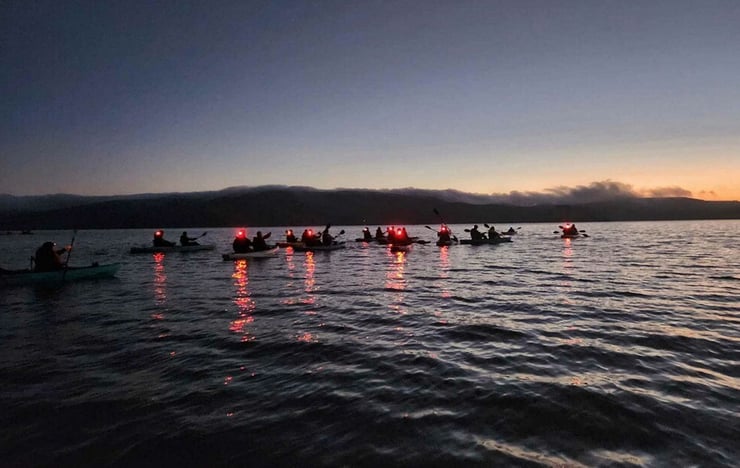
Equipment matters just as much as knowledge. Canoes are not appropriate for Tomales Bay's open, wind-exposed water. Napa Valley Paddle guides use very stable crescent crew tandem kayaks with framed elevated seats for extra back support in addition to open cockpit sit inside kayaks and 18' touring kayaks upon request for extended tours that cover more water, along with neoprene vests and splash jackets (available upon request) and every guest is briefed on the paddle technique that keeps a kayak stable when a wave hits: staying engaged with the water, blade in, rather than caught with the paddle out of the water when a swell arrives.
Guides also make the hardest call of the trip before anyone even leaves the dock: whether to run it at all. "We have a perfect track record when it comes to safety, and we'll keep you safe," Dickson says, "and unfortunately, we have to cancel often." Most cancellations come down to wind, big tides, or fog, decisions made using the marine forecast, and refined using years of pattern recognition about how this specific bay behaves. That judgment call, knowing when not to go, is something a guide provides that no amount of enthusiasm or online research can replace.
None of this is about fear. It's about respect. Roughly half of all nights on Tomales Bay are calm and glassy, especially in September and October, historically the best paddling window of the season. The point isn't that the bay is always dangerous. It's that you need someone on the water who can tell the difference between a calm night and a dangerous one, in real time, before it matters.
The Reward: One of the Most Extraordinary Sights in Nature
Here's why people keep coming back to Tomales Bay, night after night, season after season: what's waiting out there is genuinely unlike anything else.
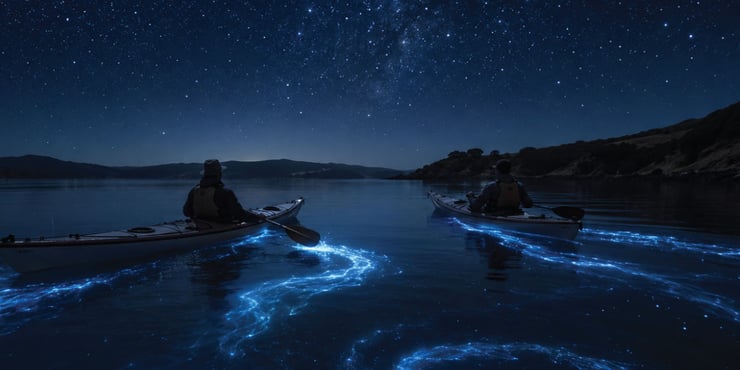
Paddle over a school of herring on a good bioluminescence night and the water beneath your kayak erupts in white-blue light with every stroke. Leopard sharks, bat rays, and halibut trace glowing outlines as they move beneath the surface, bat rays especially, their diamond shape lighting up like a shadow made of light. Tomales Bay has been ranked among the top five bioluminescence destinations in the entire world, and locals often describe it as the northern lights of the sea.
What's actually happening is that microscopic organisms called dinoflagellates flash when the water around them is disturbed, whether by a paddle, a fish, or a current. Tomales Bay is an unusually good habitat for them: nutrient-rich, cold ocean water pushes in and upwells through the bay's deep channel, while roughly twelve miles of shallow, sun-warmed water gives the bloom room to spread and multiply. That combination, cold nutrients meeting warm shallows, is part of what makes this bay one of the most reliable bioluminescence destinations on the West Coast.
There's something bigger behind the spectacle, too. More than 75% of life in the ocean uses bioluminescence in some form, whether to hunt, hide, or communicate. Many scientists believe life on Earth began in the ocean, quite possibly near deep thermal vents, which means this glow may be tracing back to something close to the origin of life itself. Under your kayak on a dark Tomales Bay night, you're not just watching a light show. You're looking at one of the oldest tricks life has ever learned.
Paddle the Bay the Way It's Meant to Be Paddled
Tomales Bay can be one of the greatest nights of your life, or it can turn dangerous in minutes if you go without the right knowledge, equipment, and judgment. The difference is almost always a guide.
Book a Bioluminescence Tour with Napa Valley Paddle
Join the Perfect Days List The best bioluminescence nights aren't a guessing game, they're a forecast. When conditions line up for calm, glassy water, especially the family-friendly nights we watch for most closely in September and October, we send word out in advance so you can grab a spot. [Sign up for the Perfect Days list] and we'll let you know as soon as a perfect night is on the horizon.
Come see the glow. Just come see it with us.